Introduction
This study of media theories tends to look at how the effect theory has evolved over time. The study looks at the history of each theory and assumption of the theory. Also, how they have changed or progressed over time and what position the theory is today. This study will explain three of the effect theories and how they relate to one another and how they still apply to the contemporary media but focusing more on online media. This study critically analysed the magic bullet theory and how it progressed into the two-step flow theory and the uses and gratification theory.
The Magic Bullet Theory/ Hypodermic Needle Theory
Harold Dwight Laswell (1902-78) was born in Illinois in the United States. He was known to be a communication theorist and a political scientist and spent most of his life work at Yale university and University of Chicago. (Dennis and Wartella 1996: 188).
Laswell’s “magic bullet” or “hypodermic needle theory” of direct influence effects was based on early observations of the effect of mass media, as used by Nazi propaganda and the effects of Hollywood in the 1930s and 1940s. (Shearo L. 2011).
The theory assumes that the media has a direct, immediate and powerful effect on the audience. It implies that the audiences are passive, and they interpret media messages all in the same way. The theory assumes that all the audience are supposed to react to the media messages the same way. Like a needle that is injected straight to the brain. According to Communications Studies Theories (2017) the core assumption of the theory is that the mass media directly and regularly influences a large number of people by ‘shooting’ or ‘injecting’ them with suitable information that is created to prompt a particular response by them.
The theory is said to suggest a powerful transmission of information directly from the sender to the receiver. The theory continues to say that the media message is like a needle that is been injected into a passive audience that uses the media. Media message was also likened to a media gun that is being shot directly into the head of the audience. (Communications Studies Theories 2017)
In the1940s and 1950s media messages were said to be a powerful influence on behavioural changes due to the popular increase in television and radio, emergence of propaganda and advertising, the Payne Fund studies of the 1930s which looked at the impact of motion picture on children and Hitler trying to join German public behind the Nazi party using the mass media during the second world war. (Davis & Baron 1981)
The media has a significant effect on the life of people. It can change how they perceive the world, or it can shape social behaviour in humans. Lippmann in 1992 said that mass communication could affect people’s view on the world. Laswell also thinks that the media can also be a tool for manipulation and social control. Perse (2001)
According to McGuire (1986) in Perse E.M. (2001: 2) the most commonly intended media effects are on advertising and purchasing, political campaign on voters, propaganda, media effect on violent behaviour and social construction of reality, effect of media bias on stereotyping or erotic or stereotyping. McGuire W.J. (1986).
The media is said to be dangerous according to the theory, as the receiver or audience of the message has no control to fight the influence of the message. The audience is also said to have no power over the escape from these effects. The audience is seen as inactive and passive and end up believing what they are told because there are no other sources of information except from the media (Communications Studies Theories 2017). A everyday example is the news. The audiences or receivers of media content like the news, have no choice than to believe whatever is in the media (agenda setting theory) because they have no other source of information except from the media. As we know the media do not always tell the story as it is. They incorporate human interest by slightly exaggerating or twisting a small incident into a big one, which the audience thinks it’s the real deal or how the event really happened.
A classic example of the Magic Bullet Theory was illustrated on October 30, 1938 when a newly formed Mercury Theatre group, Orson Welles aired their own radio edition of H.G. Wells’ “War of the Worlds.” Evening before of Halloween, for the first time a radio programming was interrupted with “news bulletin”. The audience of the show heard that a place called Grover’s Mill, New Jersey has been invaded by aliens called Martians. (Communications Studies Theories 2017)
This broadcast became known as ‘’Panic Broadcast’’ as it transformed history. Almost 12 million people were listening to the show in the United State but a million came out of their homes in panic as they believed that the alien invasion was true. This reaction disrupted a lot of homes, caused traffic jam, interrupted religious activities and clocked communication. Lots of people left their homes in the city to rural areas, attacked grocery stores and began to manage food. That media message left the city in chaos. (Communications Studies Theories 2017)
Media theorists classified the “War of the Worlds” program as an example of the Magic Bullet Theory. They explain that that is exactly how the media works as it inject the media message directly into the bloodstream of the audience to get a reaction or uniformed way of thinking. ‘’The effects of the broadcast suggested that the media could manipulate a passive and gullible public, leading theorists to believe this was one of the primary ways media authors shaped audience perception’’. (Communications Studies Theories 2017)
This paper will critically analyse how the bullet theory or hypodermic needle theory relates to the contemporary online media.
The year 2014 was a very dark one for Nigerians because of the invasion of Ebola Virus. Nigeria being a country that doesn’t like the sound of epidemic, panicked during the Ebola Virus period. A message went around the country through social media especially Facebook and WhatsApp of how salt and hot water can be used to prevent Ebola (Aliyu A. et all from Vanguard, August 8, 2014). About 1.5 billion users from 180 countries uses WhatsApp and Facebook has about 1.3 billion users (Sahir 2019). This is to testify that those two media have a very diverse audience thereby showing, to what extent the salt and water message went viral. This message caused a lot of stir with the people as lots of people believed the message and drank salt water and bath with it. In August 2014 two Nigerians reportedly died while lots of them were seriously injured. (Nwabuezer & Okonkwo 2018).
The Federal government of Nigeria had to go on air to telling people to ignore the text messages and post on social media saying salt and water and prevents Ebola or cure Ebola victims (Nwabuezer & Okonkwo 2018).
‘’The salt and water’’ message is a very good example of the bullet theory, because as the message went out lot of people started using salt and water to have their bath some even went as far as to drink it and lots of people went about looking for salt to buy from shops. The message is like the bullet that hit the people and made them go about looking for salt to the extent that lots of people ended up in the hospital.
Another case study that explains the effect theory is rumour of the monkey pox. There was a state of chaos in the eastern part of Nigeria when the rumour of the monkey pox killer vaccine broke out. The rumour stated that the Nigerian soldiers were in the state to inject children with the killer vaccine. Rumours that ignited this was that some people were saying the soldiers had vaccinated children in Nnewi and they killed over 50 children. When parents heard of this they ran to their children’s school to take them out of the house (Daily Post online, October 11, 2017). This instance is also an example of the effect of the media. The message hit parents like bullet. The parent felt the need to protect their children, they all went to school to pick their children from school. The parents that were not allowed into the school climbed the fence to get their children from school. This gave the impression that the online media deceives the audience to believe something that is not true (Nwabuezer & Okonkwo 2018). That is why this incident can also be known as the power of the media, because the effect of the message made parents withdraw their children from school without thinking of the authenticity of the message.

The media influences children, they believe things they see in the tv and most times apply it to real life. A child after watching a violent or action movie will come up to an individual with their gun (made out of their hand, stick, toys etc) to shoot people or they will test their karate moves on people by kicking and making the ‘’heyyaaa’’ sound. This further clarifies the effect of the media on children
Two pupils of Columbine High School in Littleton, Colorado on 20 April 1999 named Dylan Klebold and Eric Harris went into their school with guns, bombs and knives. These two boys walked around the school shooting and killing. By the time they were done 12 students with one teacher had died including them. After this incident people began to ask about how this has happened, and they discovered that both Klebold and Harris has learnt so much about to construct their weapon from the internet (Barlow D.M. & Mills B. 2009 pg. 420 para1). This incident is a good instance of the bullet theory, as two pupils in high school took ammunitions to school because they had seen how its being made and shot 13 people dead and also died in the process.
Jon Venables and Robert Thompson two 11 years olds on the 12 February 1993 led a toddler James Bulger whom they took at Strand Shopping Centre, Liverpool out to a disused railway line where they threw bricks at him and hit him severally till the baby died on the railway track. The process of investigation and conviction of Venables and Thompson who are very young murders led to so much assumption as to what could have led them to act the way they did. The fact that those two boys had thrown blue paint on Bulgers face showed a similarity to a horror movie called Child’s Play 3 (dir. Bender 1991). This incident led to reaction of people on how the videos are nasty and how children access them and their effect on children. The movie Child’s play 3 directly influenced the two boys to the extent that they took a toddler to a remote place to beat and stone him to death.
One of the major fears of the media is the need to protect children from the effect of what they see from the media (Barker and Petley 1997:5). Lots of research that has been done sees television as a negative influence on children. That is why Winn M. (1985: 23-34) sees the children’s use of TV as an addiction comparing it to the pleasure gotten form being on hard drugs. A contemporary example is the watching of YouTube on phones by children. A one-year old child already knows how to change content on YouTube to suit what he or she wants. If anyone including the parent tries to take the phone away the children will scream and cry.
Other bullet effect of media content on children is advertising. After watching a tv add about ice-cream or chocolate a little child will cry and tell you he or she wants that ice-cream in the television and will not stop until the ice-cream is given to him or her. Even the media has the same effect on adult after seeing a pizza commercial the process of picking up the phone to ring the pizza place to have pizza delivered is a good example of how the bullet theory work. The theory may not only apply to food, it can be mostly effective when the product advertised is easily accessed.
The effect of war photograph on individual is also an example of the magic bullet theory. Pictures war photographers take during the war has a direct influence on the people psychologically. After people see those images people will start donating money and food to those war affected countries. The media effect and hypodermic needle theory although, they have been propounded a long time ago and have been condemned, they still apply to the modern world.
A lot of theory has come to counter the magic bullet theory as being an all-powerful theory (McQuail, 2005). The hypodermic needle theory and the magic bullet theory was disproved by Lazarsfeld in the 1940s through election studies in The Peoples Choice, he then presented the two-step flow theory that same year (Griffin, 2000; McQuail, 2005). Other theories also came to challenge the magic bullet theory are the two-step flow theory and the uses and gratification theory. They see the audience as not being passive (Nwabuezer & Okonkwo 2018). They believe the audience has a choice when selecting media content and the messages does not influence them the way the magic bullet theory says it does.
The two-step flow theory
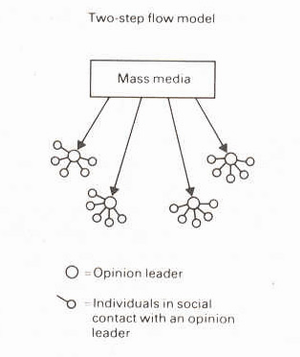
The other form of the effect theory is the two-step flow theory of communication. This theory was propounded by Paul Lazarsfeld, Bernard Berelson, and Hazel Gaudet in The People’s Choice, a 1944 study focused on the process of decision-making during a Presidential election campaign. These scholars were supposed to find the direct effect of the media on the people’s intent to vote but ended up finding that casual, personal contact were more efficient than the newspaper and radio impact on voting behaviours of people. With this information they created the two-flow theory.
The assumption of the theory is that the media messages passes two different stage. The first being that individuals (political leaders) listens to the media and relays their own interpretation of the message plus the media message to the people. The term ‘personal influence’ was invented to denote to the procedure prevailing between the media’s direct message and the audience’s reaction to that message (Communications Studies Theories 2017).
Individuals are likely to change their mind about something if their opinion leaders influence them on a subject. The two-step flow theory has made us understand how the mass media influences the decisions we make. The two-step theory can predict how a media message influences audience behaviour and it has also helped to explain why some media campaign messages have not been able to influence people’s behaviour (Communications Studies Theories 2017). This theory gave way to the multi-step flow theory of mass communication or diffusion of innovation theory.
Hardy and Scheufele (2005) note that lots of the studies of interpersonal conversation’s impact on political contribution have focused on face-to-face discussions as the only way by which residents discuss political issues with each other, but computer-mediated communications and Internet news use also make a variance in political participation. Their study found that chatting online about politics had the same controlling effects as face-to-face discussion. Weaver D. (2008)
Uses and gratification theory
What mass communication academics today refer to as the uses and gratifications (U&G) approach is known to be a type of media effects research (McQuail, 1994). To effectively analyse the audience, a research was done during the early history of communication research to know the gratification that makes an audience interested in a media and the content or product that pleases their psychological and social needs (Cantril, 1942). Much early effects research adopted the experimental or quasi-experimental approach, in which communication conditions were manipulated in search of general lessons about how better to communicate, or about the unintended consequences of messages (Klapper, 1960).
Uses and gratification theory began in the 1904s when scholars developed interest into why people choose the media they use like listening to radio watching television or reading the newspaper (Wimmer and Dominick 1994). The early uses and gratification theory was always seeking to categorize the response of the audience to media (Berelson, Lazarsfeld, & McPhee, 1954; Katz & Lazarsfeld, 1955; Lazarsfeld, Berelson, & Gaudet, 1948; Merton, 1949).
Most researchers believe that the theory do not really have theoretical consistency as its methodology was always believed primarily by the behaviourist and individualist (McQuail, 1994).
During the 1950s and 1960s researchers listed and worked out many social and psychological variable thet could have led to audience media selection (Wimmer & Dominick, 1994). Schramm, Lyle, and Parker (1961) likened the use of the television by children to build relationship with their parents and friends. Mass media was also conceptualized to be a means of escape by audience (Katz and Foulkes 1962). Klapper (1963) laid emphasis on the importance of examining the costs of use rather than simply classifying the use as earlier researchers had done. Mendelsohn (1964) listed why audiences listen to radio: ‘’companionship, bracketing the day, changing mood, counteracting loneliness or boredom, providing useful news and information, allowing vicarious participation in events, and aiding social interaction’’. Race was also suggested by Gerson (1966). Race was said to be an important thing to consider when predicting how adolescent used the media. Greenberg and Dominick (1969) concluded by analysing how race and social class foretold how teenagers used television as a casual source of learning.
The uses and gratification theory is said to be an upgrade from the magic bullet theory. Uses and gratification theory believes that the audience is not passive and that they are active and can choose what media content they want and can react to it the way they want. Klapper (1963) requested for a more functional analysis of uses and gratification studies that
would restore the audience member to “his rightful place in the dynamic, rather
than leaving him in the passive, almost inert, role to which many older studies relegated
him” (p. 527).
In conclusion the effect theory still works in the 21st century as the media still have effect on the audience. But the only thing is that the audience is not always passive. They can be passive when the message influences them personally or stare up a part in them to make them react in a certain way.
Bibliography
- Aliyu A. & Nanlong N. (2014) Ebola: Two dead, 20 others hospitalized over excessive salt consumption. with agency report https://www.vanguardngr.com/2014/08/ebola-two-die-drinking-salt-water-jos/ (1/04/19)
- Barker C. and Petley J. (1997) III Effects: The media/ violence debate, London: Routlegde.
- Barlow D.M. & Mills B. 2009 Reading Media Theory. Pearson Longman
- Berelson, B., Lazarsfeld, P. F.,&McPhee, W. N. (1954). Voting:Astudy of opinion formation in a presidential campaign. Chicago: University of Chicago Press.
- Cantril, H. (1940). The invasion from Mars: A study in the psychology of panic. Princeton, NJ: Princeton University Press.
- university of Twente Hypodermic Needle Theory Or Magic Bullet Theory: : Direct Influence Via Mass media https://www.utwente.nl/en/bms/communication-theories/sorted-by-cluster/Mass-Media/Hypodermic_Needle_Theory/ (15/04/19)
- Communications Studies Theories (2017) university of Twente Two-Step Flow Theory https://www.utwente.nl/en/bms/communication-theories/sorted-by-cluster/Mass-Media/Two_Step_Flow_Theory-1/ (15/04/19)
- Davis, D.K. & Baron, S.J. (1981). A History of Our Understanding of Mass Communication. In: Davis, D.K. & Baron, S.J. (Eds.). Mass Communication and Everyday Life: A Perspective on Theory and Effects (19-52). Belmont: Wadsworth Publishing.
- Dennis, E.E. and Wartella, E (1996) American Communication Research: The remembered history. New Jersey; Lawrence Erlbaum.
- Don Silas (2017) Monkeypox: What parents did after hearing rumour ofdeadly injection [PHOTOS] https://dailypost.ng/2017/10/12/monkeypox-parents-hearing-rumour-deadly-injection-photos/ (10/04/19)
- Gerson, W. (1966). Mass media socialization behavior: Negro–Whites differences. Social Forces, 45, 40–50.
- Greenberg, B. S., & Dominick, J. (1969). Race and social class differences in teenager’s use of television. Journal of Broadcasting, 13(4), 331–344.
- Hardy, Bruce W. & Scheufele, Dietram A. (2005). “Examining Differential Gains from Internet Use: Comparing the Moderating Role of Talk and Online Interactions,” Journal of Communication, 55 (March), pp. 71-84.
- Katz, E., & Lazarsfeld, P. F. (1955). Personal influence: The part played by people in the flow of mass communications. Glencoe, IL: Free Press.
- Klapper, J. T. (1960). The effects of mass communication. New York: Free Press.
- Klapper, J. T. (1963). Mass communication research: An old road resurveyed. Public Opinion Quarterly,27, 515–527.
- Lazarsfeld, P. F., Berelson, B.,&Gaudet, H. (1948). The people’s choice (2nd ed.). New York: Columbia University Press.
- McQuail, D. (1994). The rise of media of mass communication. In D. McQuail (Ed.), Mass communication theory: An introduction (pp. 1–29). London: Sage.
- Mendelsohn, H. (1964). Listening to the radio. In L. A. Dexter & D. M. White (Eds.), People, society and mass communication (pp. 239–248). New York: Free Press.
- Merton, R. K. (1949). Patterns of influence: Astudy of interpersonal influence and communications behaviour in a local community. In P. F. Lazarsfeld & F. N. Stanton (Eds.), Communication research, 1948–1949 (pp. 180–219). New York: Harper.
- Nwabuezer & Okonkwo (2018) Rethinking the Bullet Theory in the Digital Age; International Journal of Media, Journalism and Mass Communications Volume 4, Issue 2, 2018, PP 1-10 ISSN 2454-9479 http://dx.doi.org/10.20431/2454-9479.0402001 www.arcjournals.org
- Paul Lazarsfeld, Bernard Berelson, and Hazel Gaudet (1944) in The People’s Choice, a study focused on the process of decision-making during a Presidential election campaign.
- Perse E.M. (2001, pg 3). Media effect and society. Lippmann, W (1992). Public opinion. New York Macmillan.
- Propaganda technique in the World War [by] Harold D. Lasswell. … Lasswell, Harold D. (Harold Dwight), 1902-1978
· Sahir (2019) WhatsApp Usage, Revenue, Market Share and other Statistics https://www.digitalinformationworld.com/2019/02/whatsapp-facts-stats.html (30/03/19)
- Shearo L. (2011) Communication Theory; Mass Communication: Magic Bullet or Hypodermic Needle Theory Of Communication http://communicationtheory.org/magic-bullet-or-hypodermic-needle-theory-of-communication/ (10/04/19)
- The myth of mass media impact: Savagings and salvagings. In G. Comstock (Ed), public communication and behaviour. (vol. 1, pp 173-257). Orlando, FL: Academc Press.
- The Two-Step Flow of Communication in the 21st Century: Networks and Agendas Weaver D.(2008) http://mejo.unc.edu/sites/default/files/images/documents/ante/ante_two-step.pdf (10/04/19)
- Wadsworth.
- Wimmer, R. D., & Dominick, J. R. (1994). Mass media research: An introduction. Belmont, CA:
- Winn M. (1985) The Plug in Drugs: Television, children and the family, revised edition, New York: Penguin.
 Aishat's blog