Posts

ANALYSIS OF KEY MEDIA TREND- Academic Essay

Introduction

Technology has really helped the producers of media content reach their audience in more diverse and dynamic way and get their products to them effectively.

According to Aging In Place (2019) Digital technology has redefined what people know as ‘media.’ They said a media company is not essentially where news is gotten from; a media organization is now believed to be an organization that passes information across the globe to over 3.2 million web users.

Technology has created a platform for organization to reach their audience effectively. Creating applications with lots of features have driven people to the apps. In the past, most people access most of their media product through newspaper, magazine, television, radio etc. but now the technology has allowed people to access all this information through their phones, laptops, iPad, desktop etc.

The result of this is that lots of people can use just their technological devices (phones, laptop, desktops etc.) to access all this traditional medium with more features.

That is why I am going to analyse 3 key trends that allowed all this to be possible and those trends that will be around in the next 10 years

  1. Influencer marketers 

What is Influencer Marketing?

Influencer marketing is a common trend in which lots of media organizations uses in promoting their product. This trend is not only used by media organizations, its used by any type of organization all over the world. Influencers can vary from bloggers to celebrities who advertises or markets other people’s product for a reward or gain.

To properly understand influencer marketing, the term influencer should be explained. Influencer is a term which means, activists, comedians, bloggers, sketch artist and other social media user who uses their followers as fans (Abidin, 2016). ‘’A social media influencer is someone who has built loyal followers through their online content creation’’. (Bailis 2019). Influencers can also mean microcelebrity who keeps record of their lives in exchange for compensation (Abidin, 2014). An influencer can also be a celebrity who promotes movies or products through their page.

Influencer marketing is when organization associate with influencers to increase product awareness or conversions among a specific target audience. (Bailis 2019)

This trend is fast and growing and not slowing down. Influencer marketing industry is said to grow and reach between $5 billion and $10 billion by 2022 (SocialPubli 2019), all because 75% of marketers are using influencer marketing (Augure, 2015).

Influencer marketers use different channel to reach their audience, they use Instagram, Facebook and mostly YouTube to do a review of a product, and the response on those platforms are always magnificent. Influencers may influence many others, through their posts on social media indirectly through a flow of influence through their followers (Gladwell 2000).

In October of 2018, Shorr Packaging did an analysis of more than 1,500 YouTube user channels to know about the impact of YouTube’s influencer marketing. He got to know that adult and kids makes millions by recording videos of themselves opening boxes and playing with toys. (Wolinsky 2018).

The reason why influencing marketing is growing is the personalization of content. Customers are likely to buy a product if it makes a personal connection to humans. That is why the New Epsilon research of 2018 states that 80% of consumers are likely to buy a product when the a brand offer personalized experiences.

Influencers are not just getting popular these days, they have been in existence for a long time. Examples are the Queen and the Pope, they were believed to the be the earliest influencers. They influenced people’s opinion about drugs, by taking the drugs first to show that the drugs were safe for human consumption (Mechem 2018)

Another example is Nancy Green of 1890 who became the face of Aunt Jemima. R.T. Davis Milling Company In 1890, recruited Nancy Green to be the face of their pancake mix called “Aunt Jemima.” She represented a popular character, Aunt Jemima from a local minstrel show (Mechem 2018). Other examples are Santa Promotes Coca-Cola in 1931 and Fatty Arbuckle promoted Murad Cigarettes in 1905.
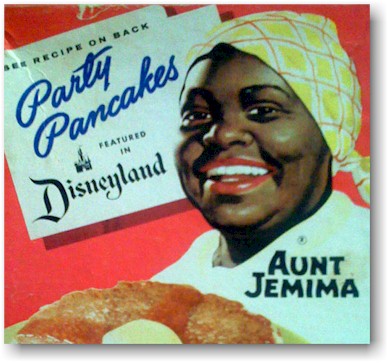
Image via The Militant Negro. Image showing the history of influencer marketing

One of the major problems with influencer marketing is ‘authenticity’. That is why there has been a demand for micro- influencers, they are the YouTubers and instagrammers who do not have millions of followers but create content of a specific niche and attract customers that are interested in their speciality. (Influencity 2018).

Influencity (2018) said the future of influencer marketing is in the hands of micro-influencers as their contents are more valuable, they are accessible influencers, they are experts in the sector and they are profiles with whom clients can easily identify.

The other issue with influencer marketing is that the influencers fail to identify their audience thereby advertising the wrong product to the wrong customer. There is a swift change in marketing strategy from traditional to social but organizations must critically analyse their market and social media behavior of customers before giving their product to influencers (Sharma S. & Albus .T.2018 ). Lots of companies struggle with influencer marketing not because the channel doesn’t work but because the sponsored content is not properly planned, implemented and executed (Bailis 2019).

Organizations must be careful when paying influencers to promote their product because there are influencers with fake followers, engagement, clicks, likes and shares. That is why an influencer will say things like; ‘’like and comment in the comment section below and give this video a thumbs up…’’ to show authenticity of their followers and engagement on their page.

That is why Unilever and Procter & Gamble are now careful when paying influencers as they pay them based on engagement to prevent paying for fake followers. Keith Weed who is the Unilever Chief Marketing and Communications Officer thinks that about 40 percent of all organization do this now to prevent been duped by fake account.(Jack 2019).

The future of influencer marketing is bright, and it will still be in trend in the next 10 years. The only change may be that influencers may go as far as producing rich content as the world is looking into more creative and personalized advertising media content. The most significant factor of influencer marketing campaigns in the future will be the human element, which will assure creative, ground-breaking and quality content (Influencity 2018).

‘’In finding a long-term place in the world of digital, influencer marketing will be successful if there is greater access to data and increased care taken during the initial planning process’’ (Richard C. 2019)

  • SUBSCRIPTION

Subscription is a trend that is growing significantly in the media industry. According to a report by Chen T. & co. (2018) 35% of the population subscribe to the media industry, 11 subscribe to the box and media industry, 4% only to box, and 51% none subscribers.

There are some apps or web that will tell you to pay first before assessing their content (itunes, spotify). Some will even let you read the first few articles or have a taste of their content and tell you to subscribe to access the rest (Deezer, quetext, grammerly etc.). Unfortunately, getting full access for the New York Times isn’t free, and it costs $15 for basic unlimited access to all articles, or $130 for a full year (Jansen M. 2019).

Nowadays people do not only subscribe to itunes or media content they also subscribe to e- commerce. According to Columbus L. (2018) ‘’The subscription to e-commerce market has grown by more than 100% percent a year over the past five years, with the largest retailers generating more than $2.6B in sales in 2016, up from $57.0M in 2011’’.

He further explained not everybody can afford this type of subscription. Subscribers are most likely to be 25 to 44 years old, to have salaries from $50,000 to $100,000, and live in urban areas.

 Another type of subscription trend is the subscription boxes. This started with Columbia records with125,175 thousand members in 1995 and 16 million subscribers in 1996. In 2010 Birchbox started the modern e-commerce we know today as their member increased to 45,000 in a year and their subscription list skyrocketed to 800,000 and 1,777% in 2.5 years. (DesMarais C. 2016)

Subscription has been gaining popularity in recent years with app developers, moving away from the traditional model of one-time pricing with paid upgrades. Chuck (2018) in an article said some developers say the steadiness of revenue from subscriptions keep them floating and counters the under-pricing pressure and “freemium” models that have been pervasive in the App Store. The money gotten from subscription gives the developers motivation to maintain and keep refining their apps Chuck (2018).

 Adobe and Microsoft have also joined the subscription trend and smaller developers have also made that switch too. Smile Software was one of the first to start charging their customer. Smile Software switched its venerable TextExpander in 2016, to a subscription plan. The consumer hated the idea which took the developers by surprise, so they gave the previous version for a single price and existing users a big discount (Chuck 2018).

Subscription is a booming trend. This act was dominated by the likes of newspapers, gyms, utilities, magazines, and telecommunications firms, but now subscription goes beyond that as its now being offered to more people. Business-to-consumer subscription; according to Daniel & Peter (2017) businesses have drew more than 11 million U.S. subscribers in 2017, and subscription has been growing at 200% yearly since 2011.

Subscription did not just start it has been in existence for a long time. The subscription model first began in the 1440s with the advent of the printing press, readers were able to enjoy their papers on the daily, weekly or monthly basis because subscription helped the printing press sustain itself and produce for its readers (The Editorial Team 2014).

The act of subscription hasn’t died in the media industry but has gone digital, almost all media organization either have a platform or media app in which they distribute their content to the audience and almost all the apps or online platform cannot be accessed without subscription. (The Editorial Team Aria 2014)

Also according to Aria ‘’Technology has always played a big role in the growth of the recurring revenue business model, highlighted in 1876 with the invention of the telephone by Alexander Graham Bell. Once telecom giant AT&T was formed in 1885 to connect local Bell companies, a monopoly was established on the communications market’’. The company could charge individuals monthly subscription fees to access the highly sought-after services.

Almost 13% of subscription businesses tracked by a subscription-related website ‘’My Subscription Addiction’’ have failed, and many more have been liquidated. Example is, Blue Apron who rose to become the largest meal kit delivery business in the U.S, went public in June, then saw its stock price fall 70%, making it the worst performing IPO of a major company so far in 2017 (Daniel & Peter 2017).

Even though subscription trends are growing the idea of Apple trying to sell all the apps is a bad idea. Bryan Jones a CodeKit developler tweeted “Subscriptions aren’t the future; nobody wants 26 subscriptions.” He also said subscriptions are a part of the future, for some certain type of app, but Apple attempting to sell every single app is bound to fail, he also said no one is going to pay for a $2 calculator.

James Thomson who is a PCalc developer took a different route. He did not follow the trend to price apps lower and lower nor went to a subscription. In the same Twitter thread, he wrote that the he believed the important thing is not to sell a $2 calculator but a $10 calculator. I don’t see the trend of subscription going anywhere in the next 10years if app developers create sensational apps people that will pay for it will pay for it regardless of the price. (Tournous C.L. 2018)

“The idea of the average household subscribing to Netfl ix, Hulu, Amazon, HBO Plus and YouTube Premium all at the same time is ludicrous,” said Farhad Massoudi, CEO of ad-supported OTT company Tubi, speaking on a panel at CES. He also continued to say an average household has an income of $54,000 a year and they are not going to spend all of it on subscription. (Frankel D. 2019)

  • Apps creation

The history of the creation of apps can be traced to Apple. The Apple App Store was introduced in July 2008, a year after the first iPhone was released. It was a revelation which had 500 apps and 10 million applications were downloaded in the first weekend (Rowinski D. 2012)

The advent of apps is a revolution for organizations, it creates a medium for business and media organization to reach their target audience and get information across to them simultaneously. ‘’The ability to send instant, non-intrusive notifications to users is so desired that it is one of the major reasons why many businesses want to have a mobile app in the first place’’ (Rowinski D. 2012).

There are two types of notification; the first is an In-app notifications these are the notifications a user of the app will receive when they have opened the app. The other is a push notification which are the notification received irrespective of any activity on the app (Rowinski D. 2012). There are also instances where the push medium of notifications has delivered click-through rates of 40% (Chen A. 2018).

Apps are more effective to reach target audience because mobile users spend just 14% of the time on websites and 86% of their time on mobile apps and the time spent on mobile app is increasing — rising by 21% in 2015 from 2014 (Deshdeep N. 2015).
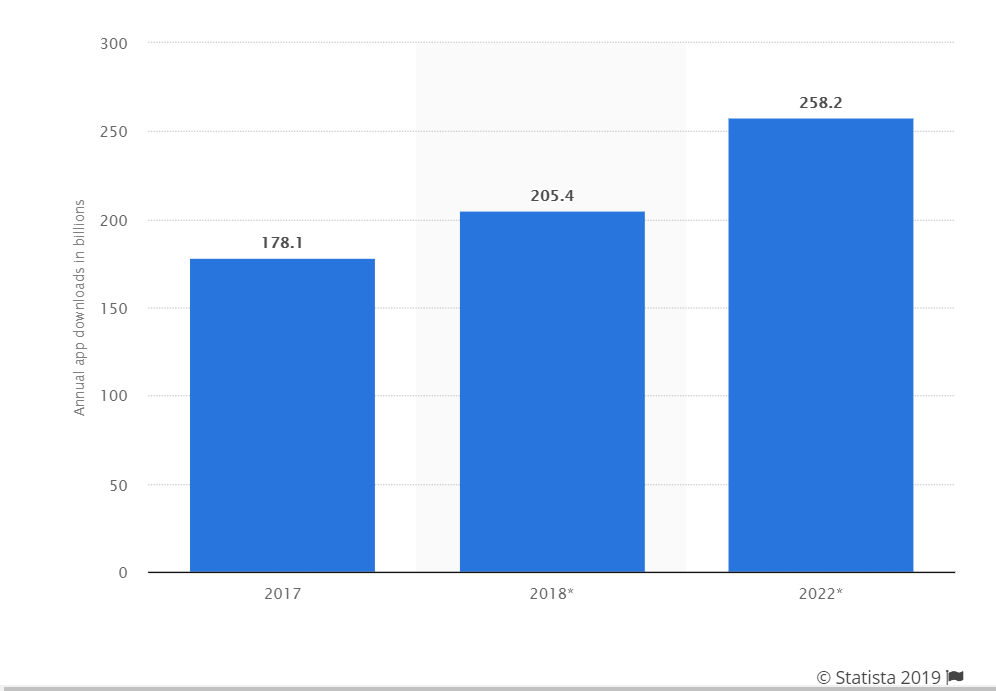
Alanysis of the diagram above shows that in 2017,  178.1 milllion apps were downloaded, in 2018, 205.4 mllion was downloaded and the chart predicted that by 2022, 258.2 million mobile apps will be downloaded. (Statista 2019). This is to show that the apps trend is not going anywhere in the next 10 years.

Statista also analysed the most downloaded non-gaming app in 2018 to be; Facebook, WhatsApp and Google. Facebook leading with 130million monthly worldwide app download.

They also analysed that large number of mobile games are also downloaded. ‘’All leading gaming app publishers on Google Play Store had double-digit download figures without any signs of slowing down’’.

Lots of companies and media organizations follow this trend, examples are the New York Times, The Guardian, Reuters, Amazon, Amazon, Bank of America, and Walmart. All this organizations uses the app to build their customer and product engagement strategies. Growing firms are also following this trend.

The mobile app is still going to be around in the next decade, the only thing is the apps will be upgraded to have more features. Artificial Intelligence is going to be included in lots of things including apps. Example is x.ai which schedules meetings for people which is very human like. Tuchscherer M. 2018 predicts that in the next 10 years people will be telling their phone to start the car and map a route to go and get something.

Artificial intelligence and machine learning are already in the apps but have not been developed properly. Chat box is an example of machine learning that is going to be a big thing in the future and Siri is an example Artificial intelligence and machine learning which can never be separated from mobile apps (Manchanda A. 2018).

One future attribute of mobile app will be the ability to streamline operations, reduce costs in hosting, give better storage, and loading capacity, are advantages of developing mobile apps over the cloud (Manchanda A. 2018).

Internet of things is also the future of app as it is said to grow $157.05 billion in 2016 to $661.74 billion by 2021 (Srivastav S. 2018).

The next-generation apps especially the gaming apps are all about AR and VR. The tech experts have predicted to generate revenue of $150 billion by the year 2020 (Pham B. 2019).

The development of greater apps can lead to the creation of a faster internet. 4G network that takes few minutes for an app to download can be upgraded to 5G where apps can be downloaded in seconds (Pham B. 2019).

All the trend analysed above shows that technology has always affected the media content we consume. Without technology all discussed above would not have been possible at all. Platform and content are also very important but without technology, all the good content will not reach the desired audience and there will be no platform to display content to the consumer.

BIBLIOGRAPHY

Abidin, C. (2014). Privacy for profit: Commodifying privacy in lifestyle blogging. In Selected Papers of Internet Research 15: The 15th Annual Meeting of the Association of Internet Researchers. Retrieved from https://firstmonday.org/ojs//index.php/spir/article/view/8800 

Abidin, C. (2016). “Aren’t these just young, rich women doing vain things online?”: Influencer selfies as subversive frivolity. Social Media+ Society, 2(2), 1-17. 

Aging In Place (2019) ‘’Technology In Our Life Today And How It Has Changed.’’ Retrieved from URL: https://www.aginginplace.org/technology-in-our-life-today-and-how-it-has-changed/  Accessed at: 02, April,019.

Augure (2015). ‘’The state of influencer engagement: 2015.  Accessed at URL; https://www.launchmetrics.com/resources/ whitepapers/the-state-of-influencer-engagement-Retieved by: 27/03/19

Bailis R. (2019) ‘’The State of Influencer Marketing: 10 Influencer Marketing Statistics to Inform Where You Invest’’ Accessed at URL:  https://www.bigcommerce.com/blog/influencer-marketing-statistics/#what-is-influencer-marketing   Retrieved by: 30 March, 2019.

Chen A. (2018) ‘’New data on push notifications show up to 40% CTRs, the best performs 4X better than the worst (Guest post).  Accessed at URL:  https://andrewchen.co/new-data-on-push-notification-ctrs-shows-the-best-apps-perform-4x-better-than-the-worst-heres-why-guest-post/ Retrieved by: 30 March, 2019.

Chen T. & co. (2018) ‘’Thinking outside the subscription box: new research on e-commerce consumer’’ Accessed at URL:  https://www.mckinsey.com/industries/high-tech/our-insights/thinking-inside-the-subscription-box-new-research-on-ecommerce-consumers .Retrieved by: 31 March, 2019.

Chuck L.T (2018) Macworld – Digital Edition ‘’How Apple’s push to subscriptions could save the App Store and cost you money’’. Vol. 35 Issue 11, p13-18. 6p. 4

Columbus L. (2018) ‘’The State Of The Subscription Economy, 2018’’

Daniel M. and Peter F. (2017) Harvard Business Review Digital ‘’Subscription Businesses Are Booming. Here’s How to Value Them’’. PG 1-6

Deshdeep N. 2015 ‘’10 Reasons Why Mobile Apps are Better Than Mobile Websites’’  Accessed at URL:  https://vwo.com/blog/10-reasons-mobile-apps-are-better/ Retrieved by: 4th April, 2019.

DesMarais C. 2016) ‘’Here’s How Much People Like Their Subscription Boxes (Infographic)’’ Accessed at URL:  https://www.inc.com/christina-desmarais/heres-data-showing-the-crazy-growth-of-subscription-box-services-infographic.html Retrieved by: 7th April, 2019

Frankel D. (2019) Broadcasting & Cable Raises Prices as Consumer Subscription Spending Tightens Vol. 149 Issue 1

Gladwell, M. 2000. The tipping point: How little things can make a big difference. New York, NY: Little Brown.  Accessed at URL :https://www.forbes.com/sites/louiscolumbus/2018/03/04/the-state-of-the-subscription-economy-2018/#4ab2265d53ef Retrieved by: 10th April, 2019

Influencity  (2018)‘’Influencer Marketing trends for 2019’’ Accessed at URL:  https://influencity.com/blog/en/influencer-marketing-trends-for-2019/ Retrieved by: March 24 2019

Jack N. (2019) Advertising Age ‘’HOW TO SUCCEED WITH INFLUENCERS: Influencer marketing is becoming a bigger piece of the toolbox. Here’s how not to mess it up’’. Vol. 90 Issue 2, p19-19.

Jansen M. (2019) ‘’The Best new apps for android and ios’’ Accessed at URL:  https://www.digitaltrends.com/mobile/best-news-apps/ Retrieved by: 5th April, 2019

Manchanda A. (2018) ‘’12 Mobile App Development Trends to Watch Out for in 2019’’ Accessed at URL:  https://www.netsolutions.com/insights/12-mobile-app-development-trends-to-watch-out-for-in-2019/ Retrieved by: 3rd April, 2019

Mechem B. (2018) ‘’The History of Influencer Marketing: How It Has Evolved Over the Years’’  Accessed at URL:  https://www.grin.co/blog/the-history-of-influencer-marketing-how-it-has-evolved-over-the-years Retrieved by: 3rd April, 2019

Number of mobile app downloads worldwide in 2017, 2018 and 2022 (in billions) Accessed at URL:  https://www.statista.com/statistics/271644/worldwide-free-and-paid-mobile-app-store-downloads/  2019 Statista Retrieved by: 5th April, 2019

Pham B. (2019) ‘’Top Mobile App Development Trends in 2019’’ Accessed at URL:  https://customerthink.com/top-mobile-app-development-trends-in-2019/  Retrieved by: 3rd April, 2019

Pressroom (2018) Epsilon ‘’Digital Transformation Team Helps Brands Assess the People, Process and Technology Required to Deliver the Best Personalized Customer Experiences’’ Accessed at URL:  https://us.epsilon.com/pressroom/new-epsilon-research-indicates-80-of-consumers-are-more-likely-to-make-a-purchase-when-brands-offer-personalized-experiences Retrieved by: 3rd April, 2019

Richard C. (2019) Business + Management ‘’Influencer marketing: addressing the challenges’’   Vol. 33 Issue 1, p38-39. 2p.

Rowinski D. ‘’The history of apps can be traced to the advent of Apple’s App Store Starting in 2008.’’ Accessed at URL: https://readwrite.com/2012/02/07/infographic_history_of_mobile_app_stores-2/ Retrieved by: 7th April, 2019

Sharma .S. & Albus .T.2018  Influencer Marketing Strategies for Indie, Mass and Luxury Brands Vol. 186 Issue 7, pDE11-DE14. 4p

SocialPubli (2019). ‘’2019 Influencer Marketing Report: A Marketer’s Perspective’’ Accessed at URL:  https://socialpubli.com/blog/wp-content/uploads/dlm_uploads/2019/01/BACKUP-The-State-of-Influencers-Marketing-seen-by-advertisers-2019-.pdf Retrieved by: 7th April, 2019

Srivastav S. (2018) ‘’11 Mobile App Trends That Will Dominate in 2018’’ Accessed at URL:  https://appinventiv.com/blog/11-mobile-app-trends-that-will-dominate-2018 Retrieved by: 8th April, 2019

The editorial team (2014) ARIA ‘’The history of recurring revenue’’ Accessed at URL:  https://www.ariasystems.com/blog/author/editorial_team/ Retrieved by: 9th April, 2019

Tournous C.L. (2018)‘’How Apple’s push to subscriptions could save the App Store and cost you money’’ Accessed at URL:  https://www.macworld.com/article/3301860/apple-push-to-subscriptions.html Retrieved by: 10th April, 2019

Tuchscherer M. (2018), Future or Anything.  ‘’What’s the Future of Apps?’’ Accessed at URL:  https://www.futureofeverything.io/ask-thought-leaders-whats-future-apps/ Retrieved by: 4th April, 2019

Weiss M. (2018) Digiday Research: ‘’Five key trends that will shape media and marketing in 2019’’ Accessed at URL:  https://digiday.com/media/digiday-research-five-key-trends-that-will-shape-media-and-marketing-in-2019/ Retrieved by: 7th April, 2019

Wolinsky J. 2018 ‘’YouTube Influencer Marketing Trends For 2019’’ Accessed at URL:  https://www.valuewalk.com/2018/12/youtube-influencer-marketing/ Retrieved by: 7th April, 2019.

Waiting for “Godot”: The Dublin Bus Never Shows up at the Right Time

 The Dublin Bus App and on-screen display unit  never shows the real time information.

‘‘I have had experiences of waiting for more than 50 mins and an hour for the bus even when the bus app and on-street display showed the bus is due’’

In a survey of 20 people it was concluded that 18 out of 20 has one or two problem with the Dublin bus app and the on-street display units at bus stops. Only two said the bus app works perfectly for them and 18 said the bus keeps them waiting. The issue with the bus app is not new, but little to no press coverage has been awarded to this issue which needs to be fixed. The bus apps and on-street display units work properly in most part of Dublin while it doesn’t work in some part. This is due to the fact that the NTA (National Tranport Authority) do not do a proper check-up on the bus.

Image showing people waiting for the bus
Source: Paul Briffa/ flickr creative commons

A bus user Blessing Ezike said in an interview ‘the bus app is not accurate. It doesn’t come regularly and comes mostly late and sometimes comes as late as 1 hour and the worst part is sometimes it passes me by even after waving. It has done that to me more than twice now’. Ezike continued to say the on-street display keeps changing and reading one minutes for more than 5 minutes, although that is not the case for all the buses.

Teni Bamidele also a frequent user of the bus said, ‘the bus app is not accurate, but it is good and useful at the same time’. Then continued to say ‘although, the on-street display works properly but not all the time. Buses even makes me we wait for more than 30 minutes, it will write on the on-street display that the bus is coming and ends up not showing up or shows up late’.

 ‘In some places the bus app works well and in some places it’s just terrible. The on-street display at the stops does not work well either there has been a case where the display showed me that the bus will come in the next one minute, but it disappeared then showed up later reading its coming in the next 23 minutes’.

Adenuga also continued saying ‘I have had experiences of waiting for more than 50 mins and an hour for the bus even when the bus app and on-street display showed the bus is due’.

Idara Micheal also a bus user said ‘the Dublin bus app works perfectly well for me. The problem is the bus not the bus app. Bus sometimes the on-street display says the bus will come then it just disappears and there was a day I waved for the bus, but it did not stop’.

Ezike said she will like the government to fix any on-street display that has technical problems or regulate the bus app so as not to ruin people’s appointment or day.‘Some bus even moves in an hour interval which is very bad. If I miss the bus I had to wait for the next one hour for the next one. I beg the government to do something about that.’

In an article written by the Journal on the Dublin bus. A bus user claimed that the bus app doesn’t work properly by saying ‘when it says I have 4 mins to get to a bus stop that is 30 seconds away, and the bus comes flying past and (is) gone within 6 seconds of checking that, something needs to change. It’s a TRACKING app, where did those 4 minutes go?

All these are proving that the bus apps have been having problems for a long time but little to nothing is done to make the bus app work.

Mark Beegan form the Media and Communications Department of the Dublin Bus, in their defence said ‘’Independent surveys of the accuracy of the system show that the Dublin Bus RTPI system is over 97.5% accurate. This is one of the more accurate systems across the world.’

Beegan also said that the reason why the on-screen display unit shows the bus coming and doesn’t come is because ‘Every trip a bus is scheduled to make is programmed into our RTPI system. Scheduled predictions for every trip appear on the RTPI app and the on-street screens automatically from 60 mins before the start time of the journey. This prediction remains in place until a bus commences its trip.’

‘Each trip is also associated with a ‘‘board’’ (daily assigned trips for a bus). Once the bus communicates with the system for its board this essentially takes over and provides real-time information for all trips assigned to that board.  This is when the GPS element kicks in and tracks the bus as it moves along its route. If the bus assigned has not communicated to a particular board (i.e. doesn’t operate) the first trip on the board will continue to be displayed for all stops within 60 minutes of the trip start time.’

‘Predictions will continue until the trip is removed from that stop in our system by our team of inspectors in Central Control or the start time of that trip from the terminus has elapsed. Therefore a trip may appear for stops close to the terminus, countdown to due but then the

Text Box: ‘‘NTA undertake on-going surveys of the accuracy of the RTPI system and recent surveys in Dublin show the system is operated at an accuracy of 97% on average over 2017.  This accuracy level has improved year on year and Dublin is now one of the strongest performers in Real Time Passenger Information.’’bus may not arrive’.

When Beegan was asked how frequent the bus app is being regulated he said ‘NTA and Dublin Bus closely monitor this system and will continue to make adjustments to provide as accurate information as possible.’

In an interview with Dermot O’Gara the Head of Public Affairs of the National Transport Authority (NTA) on why the bus app does not work properly he said research has been done into the real time information and it works properly and its 90% accurate.

O’Gara said that NTA do their own research on a larger scale and its more than 90% accurate and does not think that there is a problem with the bus app and the on-street display unit.   During the interview O’Gara said the bus app is regulated once a year and is done regularly.

This investigation reveals that there is a problem with the regulatory body in charge of the Dublin bus, as the NTA and Dublin bus thinks there is no problem with the app and on-street display whereas there is big problem. The regulatory body needs to see the peoples view about this matter to know how bad it is.

“One death is too many the goal is to record zero death in Ireland” says Ms. Sarah Benson

Image from the seminar taken by Aishat

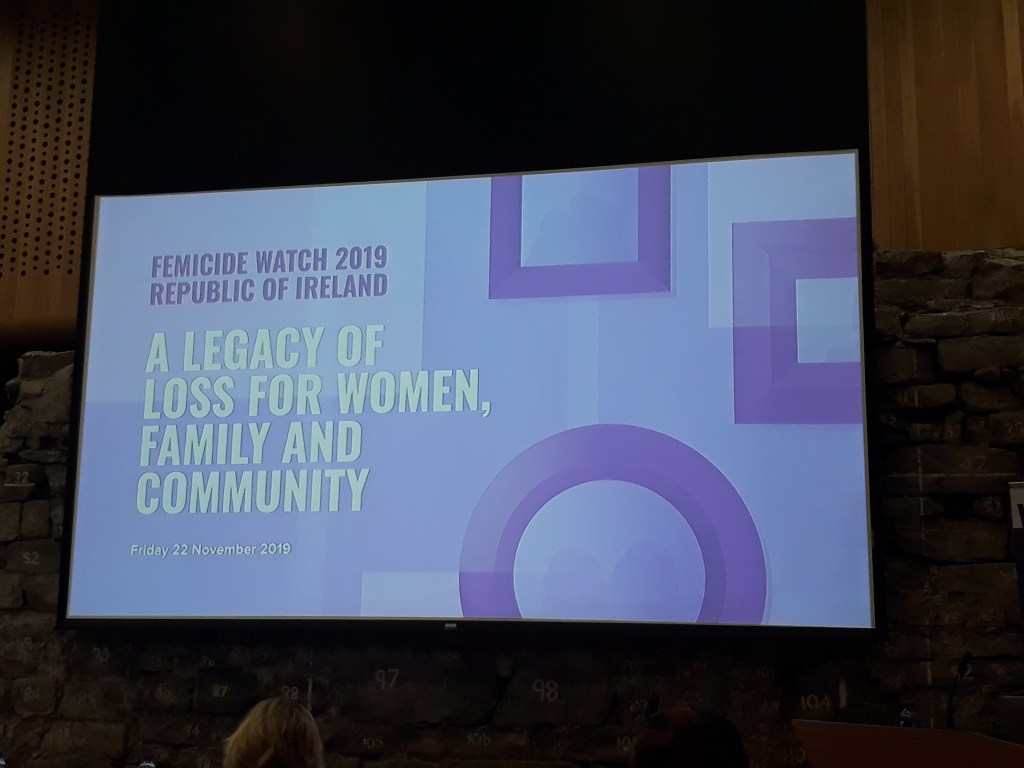
Ms. Sarah Benson the CEO of Women’s Aid said that her goal is to make sure that victims of abuse reduces drastically. She said this at the Dublin City council office during the lecture on the Femicide report on Friday, [ 22 November 2019].

Ms. Benson said 230 women have been killed and 16 children have died alongside their mother since the Women’s Aid started reporting in 1996, 87% of them were killed by men they know, 56% were killed by current boyfriend, husband or partner and 5 women have died in the Ireland this year.

She said that the organization lunches its new report named “A legacy of Loss- Femicide Watch 2019” which reports that women are more likely to die in their own homes and by men known to them. She expresses her worries about women being in danger in a place where they ought to feel the safe (that is their homes).

Image showing the exhibition called “Legacy of Loss” shots taken by Aishat Ibrahim

During the event, victims, professionals and experts were present at the event. Mr Ryan Hart who was a victim was invited to tell his story. Mr Hart narrated how his father had killed his mother (Claire) and sister (Charlotte) using a sawn-off shotgun in broad daylight and then committed suicide after. He and his brother Luke speak openly about their story and uses it to raise awareness of the coercive and controlling behaviour their family had suffered.

“Men like my father believe that they are entitled to control and abuse their family and we have to have the media challenging these believes.” Mr Ryan Hart

What he and his brother found reported in the media days after the murder is excusing his father’s action and the media blaming them for provoking their father rather than focusing on the victims which is his sister and mother.

Mr Hart said that in some report his father was named a “nice guy” which to him was wrong. He said the media needed to reform how they report homicide cases. He continued to say most murders in the media were reported by blaming the actions of the murders, on mental health, addiction and alcohol, which in the process is giving limelight to the evil doers and creating room for more people to kill.

He said journalist should not ask neighbours what the attacker was like, “because an abuser keeps their abuse hidden”.

“He has controlled the victim’s life now he’s going to control the narrative too” Says Mr. Ryan Hart

He said journalist giving prominence to reporting from the murderer’s perspectives have created a platform for murders to control victims and control the narrative too. He and his brother Luke found out that his father has been reading articles on how to kill the whole family before he actually did.

Dr. Anne O’Brien a lecturer at Maynooth University also spoke at the event where she said sensitive cases such as intimate partner homicide when reported, are decontextualized, blames are shifted on the perpetuator rather than the victims, and patterns to sources journalist uses remain the same rather than stories from family of the victims or experts.

Ms Benson implored the government to introduce proper resources and legislate formal Domestic Homicide Reviews (DHRs) and increase the support for families bereaved due to domestic homicide.

The event was chaired by Claire Byrne who is a broadcaster from RTE. Experts like Nora Gibbons and Frank Mullane who are experts were present. Kathleen Chada, who is a victim whose sons were murdered by their father could not make it to the event today to tell her story and share her grieving process.

 If you have been abused or knows anyone that need help, the 24hour National Freephone Helpline is 1800341900. Save a life today/ save yours.

The Effect Theory- Academic Essay

Introduction

This study of media theories tends to look at how the effect theory has evolved over time. The study looks at the history of each theory and assumption of the theory.  Also, how they have changed or progressed over time and what position the theory is today. This study will explain three of the effect theories and how they relate to one another and how they still apply to the contemporary media but focusing more on online media. This study critically analysed the magic bullet theory and how it progressed into the two-step flow theory and the uses and gratification theory.

The Magic Bullet Theory/ Hypodermic Needle Theory

Harold Dwight Laswell (1902-78) was born in Illinois in the United States. He was known to be a communication theorist and a political scientist and spent most of his life work at Yale university and University of Chicago. (Dennis and Wartella 1996: 188).

Laswell’s “magic bullet” or “hypodermic needle theory” of direct influence effects was based on early observations of the effect of mass media, as used by Nazi propaganda and the effects of Hollywood in the 1930s and 1940s. (Shearo L. 2011).

The theory assumes that the media has a direct, immediate and powerful effect on the audience. It implies that the audiences are passive, and they interpret media messages all in the same way. The theory assumes that all the audience are supposed to react to the media messages the same way. Like a needle that is injected straight to the brain. According to Communications Studies Theories (2017) the core assumption of the theory is that the mass media directly and regularly influences a large number of people by ‘shooting’ or ‘injecting’ them with suitable information that is created to prompt a particular response by them.

The theory is said to suggest a powerful transmission of information directly from the sender to the receiver. The theory continues to say that the media message is like a needle that is been injected into a passive audience that uses the media. Media message was also likened to a media gun that is being shot directly into the head of the audience. (Communications Studies Theories 2017)

In the1940s and 1950s media messages were said to be a powerful influence on behavioural changes due to the popular increase in television and radio, emergence of propaganda and advertising, the Payne Fund studies of the 1930s which looked at the impact of motion picture on children and Hitler trying to join German public behind the Nazi party using the mass media during the second world war. (Davis & Baron 1981)

The media has a significant effect on the life of people. It can change how they perceive the world, or it can shape social behaviour in humans. Lippmann in 1992 said that mass communication could affect people’s view on the world. Laswell also thinks that the media can also be a tool for manipulation and social control. Perse (2001)

According to McGuire (1986) in Perse E.M. (2001: 2) the most commonly intended media effects are on advertising and purchasing, political campaign on voters, propaganda, media effect on violent behaviour and social construction of reality, effect of media bias on stereotyping or erotic or stereotyping. McGuire W.J. (1986).

The media is said to be dangerous according to the theory, as the receiver or audience of the message has no control to fight the influence of the message. The audience is also said to have no power over the escape from these effects. The audience is seen as inactive and passive and end up believing what they are told because there are no other sources of information except from the media (Communications Studies Theories 2017). A everyday example is the news. The audiences or receivers of media content like the news, have no choice than to believe whatever is in the media (agenda setting theory) because they have no other source of information except from the media. As we know the media do not always tell the story as it is. They incorporate human interest by slightly exaggerating or twisting a small incident into a big one, which the audience thinks it’s the real deal or how the event really happened.

A classic example of the Magic Bullet Theory was illustrated on October 30, 1938 when a newly formed Mercury Theatre group, Orson Welles aired their own radio edition of H.G. Wells’ “War of the Worlds.”   Evening before of Halloween, for the first time a radio programming was interrupted with “news bulletin”. The audience of the show heard that a place called Grover’s Mill, New Jersey has been invaded by aliens called Martians. (Communications Studies Theories 2017)

This broadcast became known as ‘’Panic Broadcast’’ as it transformed history. Almost 12 million people were listening to the show in the United State but a million came out of their homes in panic as they believed that the alien invasion was true. This reaction disrupted a lot of homes, caused traffic jam, interrupted religious activities and clocked communication. Lots of people left their homes in the city to rural areas, attacked grocery stores and began to manage food. That media message left the city in chaos. (Communications Studies Theories 2017)

Media theorists classified the “War of the Worlds” program as an example of the Magic Bullet Theory. They explain that that is exactly how the media works as it inject the media message directly into the bloodstream of the audience to get a reaction or uniformed way of thinking. ‘’The effects of the broadcast suggested that the media could manipulate a passive and gullible public, leading theorists to believe this was one of the primary ways media authors shaped audience perception’’. (Communications Studies Theories 2017)

This paper will critically analyse how the bullet theory or hypodermic needle theory relates to the contemporary online media.

The year 2014 was a very dark one for Nigerians because of the invasion of Ebola Virus. Nigeria being a country that doesn’t like the sound of epidemic, panicked during the Ebola Virus period. A message went around the country through social media especially Facebook and WhatsApp of how salt and hot water can be used to prevent Ebola (Aliyu A. et all from Vanguard, August 8, 2014). About 1.5 billion users from 180 countries uses WhatsApp and Facebook has about 1.3 billion users (Sahir 2019). This is to testify that those two media have a very diverse audience thereby showing, to what extent the salt and water message went viral. This message caused a lot of stir with the people as lots of people believed the message and drank salt water and bath with it.  In August 2014 two Nigerians reportedly died while lots of them were seriously injured. (Nwabuezer & Okonkwo 2018).

The Federal government of Nigeria had to go on air to telling people to ignore the text messages and post on social media saying salt and water and prevents Ebola or cure Ebola victims (Nwabuezer & Okonkwo 2018).

‘’The salt and water’’ message is a very good example of the bullet theory, because as the message went out lot of people started using salt and water to have their bath some even went as far as to drink it and lots of people went about looking for salt to buy from shops. The message is like the bullet that hit the people and made them go about looking for salt to the extent that lots of people ended up in the hospital.

Another case study that explains the effect theory is rumour of the monkey pox. There was a state of chaos in the eastern part of Nigeria when the rumour of the monkey pox killer vaccine broke out. The rumour stated that the Nigerian soldiers were in the state to inject children with the killer vaccine. Rumours that ignited this was that some people were saying the soldiers had vaccinated children in Nnewi and they killed over 50 children. When parents heard of this they ran to their children’s school to take them out of the house (Daily Post online, October 11, 2017). This instance is also an example of the effect of the media. The message hit parents like bullet. The parent felt the need to protect their children, they all went to school to pick their children from school. The parents that were not allowed into the school climbed the fence to get their children from school. This gave the impression that the online media deceives the audience to believe something that is not true (Nwabuezer & Okonkwo 2018). That is why this incident can also be known as the power of the media, because the effect of the message made parents withdraw their children from school without thinking of the authenticity of the message.

Image by the Daily Post Online. Image showing parents jumping the fence to take their children away from school.

The media influences children, they believe things they see in the tv and most times apply it to real life. A child after watching a violent or action movie will come up to an individual with their gun (made out of their hand, stick, toys etc) to shoot people or they will test their karate moves on people by kicking and making the ‘’heyyaaa’’ sound. This further clarifies the effect of the media on children

Two pupils of Columbine High School in Littleton, Colorado on 20 April 1999 named Dylan Klebold and Eric Harris went into their school with guns, bombs and knives. These two boys walked around the school shooting and killing. By the time they were done 12 students with one teacher had died including them. After this incident people began to ask about how this has happened, and they discovered that both Klebold and Harris has learnt so much about to construct their weapon from the internet (Barlow D.M. & Mills B. 2009 pg. 420 para1). This incident is a good instance of the bullet theory, as two pupils in high school took ammunitions to school because they had seen how its being made and shot 13 people dead and also died in the process.

Jon Venables and Robert Thompson two 11 years olds on the 12 February 1993 led a toddler James Bulger whom they took at Strand Shopping Centre, Liverpool out to a disused railway line where they threw bricks at him and hit him severally till the baby died on the railway track. The process of investigation and conviction of Venables and Thompson who are very young murders led to so much assumption as to what could have led them to act the way they did. The fact that those two boys had thrown blue paint on Bulgers face showed a similarity to a horror movie called Child’s Play 3 (dir. Bender 1991). This incident led to reaction of people on how the videos are nasty and how children access them and their effect on children. The movie Child’s play 3 directly influenced the two boys to the extent that they took a toddler to a remote place to beat and stone him to death.

One of the major fears of the media is the need to protect children from the effect of what they see from the media (Barker and Petley 1997:5). Lots of research that has been done sees television as a negative influence on children. That is why Winn M. (1985: 23-34) sees the children’s use of TV as an addiction comparing it to the pleasure gotten form being on hard drugs. A contemporary example is the watching of YouTube on phones by children. A one-year old child already knows how to change content on YouTube to suit what he or she wants. If anyone including the parent tries to take the phone away the children will scream and cry.

Other bullet effect of media content on children is advertising. After watching a tv add about ice-cream or chocolate a little child will cry and tell you he or she wants that ice-cream in the television and will not stop until the ice-cream is given to him or her. Even the media has the same effect on adult after seeing a pizza commercial the process of picking up the phone to ring the pizza place to have pizza delivered is a good example of how the bullet theory work. The theory may not only apply to food, it can be mostly effective when the product advertised is easily accessed.

The effect of war photograph on individual is also an example of the magic bullet theory. Pictures war photographers take during the war has a direct influence on the people psychologically. After people see those images people will start donating money and food to those war affected countries. The media effect and hypodermic needle theory although, they have been propounded a long time ago and have been condemned, they still apply to the modern world.

A lot of theory has come to counter the magic bullet theory as being an all-powerful theory (McQuail, 2005). The hypodermic needle theory and the magic bullet theory was disproved by Lazarsfeld in the 1940s through election studies in The Peoples Choice, he then presented the two-step flow theory that same year (Griffin, 2000; McQuail, 2005). Other theories also came to challenge the magic bullet theory are the two-step flow theory and the uses and gratification theory. They see the audience as not being passive (Nwabuezer & Okonkwo 2018). They believe the audience has a choice when selecting media content and the messages does not influence them the way the magic bullet theory says it does.

The two-step flow theory

The other form of the effect theory is the two-step flow theory of communication. This theory was propounded by Paul Lazarsfeld, Bernard Berelson, and Hazel Gaudet in The People’s Choice, a 1944 study focused on the process of decision-making during a Presidential election campaign. These scholars were supposed to find the direct effect of the media on the people’s intent to vote but ended up finding that casual, personal contact were more efficient than the newspaper and radio impact on voting behaviours of people. With this information they created the two-flow theory.

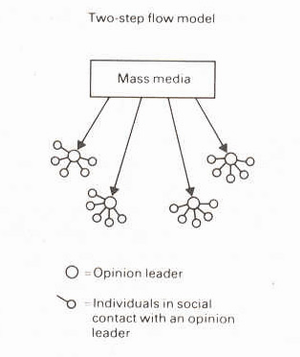
The assumption of the theory is that the media messages passes two different stage. The first being that individuals (political leaders) listens to the media and relays their own interpretation of the message plus the media message to the people. The term ‘personal influence’ was invented to denote to the procedure prevailing between the media’s direct message and the audience’s reaction to that message (Communications Studies Theories 2017).

Individuals are likely to change their mind about something if their opinion leaders influence them on a subject. The two-step flow theory has made us understand how the mass media influences the decisions we make. The two-step theory can predict how a media message influences audience behaviour and it has also helped to explain why some media campaign messages have not been able to influence people’s behaviour (Communications Studies Theories 2017). This theory gave way to the multi-step flow theory of mass communication or diffusion of innovation theory.

Source: Katz & Lazarsfeld (1955)

Hardy and Scheufele (2005) note that lots of the studies of interpersonal conversation’s impact on political contribution have focused on face-to-face discussions as the only way by which residents discuss political issues with each other, but computer-mediated communications and Internet news use also make a variance in political participation. Their study found that chatting online about politics had the same controlling effects as face-to-face discussion. Weaver D. (2008)

Uses and gratification theory

What mass communication academics today refer to as the uses and gratifications (U&G) approach is known to be a type of media effects research (McQuail, 1994). To effectively analyse the audience, a research was done during the early history of communication research to know the gratification that makes an audience interested in a media and the content or product that pleases their psychological and social needs (Cantril, 1942). Much early effects research adopted the experimental or quasi-experimental approach, in which communication conditions were manipulated in search of general lessons about how better to communicate, or about the unintended consequences of messages (Klapper, 1960).

Uses and gratification theory began in the 1904s when scholars developed interest into why people choose the media they use like listening to radio watching television or reading the newspaper (Wimmer and Dominick 1994).  The early uses and gratification theory was always seeking to categorize the response of the audience to media (Berelson, Lazarsfeld, & McPhee, 1954; Katz & Lazarsfeld, 1955; Lazarsfeld, Berelson, & Gaudet, 1948; Merton, 1949).

Most researchers believe that the theory do not really have theoretical consistency as its methodology was always believed primarily by the behaviourist and individualist (McQuail, 1994).

During the 1950s and 1960s researchers listed and worked out many social and psychological variable thet could have led to audience media selection (Wimmer & Dominick, 1994). Schramm, Lyle, and Parker (1961) likened the use of the television by children to build relationship with their parents and friends. Mass media was also conceptualized to be a means of escape by audience (Katz and Foulkes 1962). Klapper (1963) laid emphasis on the importance of examining the costs of use rather than simply classifying the use as earlier researchers had done. Mendelsohn (1964) listed why audiences listen to radio: ‘’companionship, bracketing the day, changing mood, counteracting loneliness or boredom, providing useful news and information, allowing vicarious participation in events, and aiding social interaction’’. Race was also suggested by Gerson (1966). Race was said to be an important thing to consider when predicting how adolescent used the media. Greenberg and Dominick (1969) concluded by analysing how race and social class foretold how teenagers used television as a casual source of learning.

The uses and gratification theory is said to be an upgrade from the magic bullet theory. Uses and gratification theory believes that the audience is not passive and that they are active and can choose what media content they want and can react to it the way they want. Klapper (1963) requested for a more functional analysis of uses and gratification studies that

would restore the audience member to “his rightful place in the dynamic, rather

than leaving him in the passive, almost inert, role to which many older studies relegated

him” (p. 527).

In conclusion the effect theory still works in the 21st century as the media still have effect on the audience. But the only thing is that the audience is not always passive. They can be passive when the message influences them personally or stare up a part in them to make them react in a certain way.

Bibliography

  • Aliyu A. & Nanlong N. (2014) Ebola: Two dead, 20 others hospitalized over excessive salt consumption. with agency report https://www.vanguardngr.com/2014/08/ebola-two-die-drinking-salt-water-jos/ (1/04/19)
  • Barker C. and Petley J. (1997) III Effects: The media/ violence debate, London: Routlegde.
  • Barlow D.M. & Mills B. 2009 Reading Media Theory. Pearson Longman
  • Berelson, B., Lazarsfeld, P. F.,&McPhee, W. N. (1954). Voting:Astudy of opinion formation in a presidential campaign. Chicago: University of Chicago Press.
  • Cantril, H. (1940). The invasion from Mars: A study in the psychology of panic. Princeton, NJ: Princeton University Press.
  • university of Twente Hypodermic Needle Theory Or Magic Bullet Theory: : Direct Influence Via Mass media https://www.utwente.nl/en/bms/communication-theories/sorted-by-cluster/Mass-Media/Hypodermic_Needle_Theory/ (15/04/19)
  • Communications Studies Theories (2017) university of Twente Two-Step Flow Theory https://www.utwente.nl/en/bms/communication-theories/sorted-by-cluster/Mass-Media/Two_Step_Flow_Theory-1/ (15/04/19)
  • Davis, D.K. & Baron, S.J. (1981). A History of Our Understanding of Mass Communication. In: Davis, D.K. & Baron, S.J. (Eds.). Mass Communication and Everyday Life: A Perspective on Theory and Effects (19-52). Belmont: Wadsworth Publishing.
  • Dennis, E.E. and Wartella, E (1996) American Communication Research: The remembered history. New Jersey; Lawrence Erlbaum.
  • Don Silas (2017) Monkeypox: What parents did after hearing rumour ofdeadly injection [PHOTOS] https://dailypost.ng/2017/10/12/monkeypox-parents-hearing-rumour-deadly-injection-photos/  (10/04/19)
  • Gerson, W. (1966). Mass media socialization behavior: Negro–Whites differences. Social Forces, 45, 40–50.
  • Greenberg, B. S., & Dominick, J. (1969). Race and social class differences in teenager’s use of television. Journal of Broadcasting, 13(4), 331–344.
  • Hardy, Bruce W. & Scheufele, Dietram A. (2005). “Examining Differential Gains from Internet Use: Comparing the Moderating Role of Talk and Online Interactions,” Journal of Communication, 55 (March), pp. 71-84.
  • Katz, E., & Lazarsfeld, P. F. (1955). Personal influence: The part played by people in the flow of mass communications. Glencoe, IL: Free Press.
  • Klapper, J. T. (1960). The effects of mass communication. New York: Free Press.
  • Klapper, J. T. (1963). Mass communication research: An old road resurveyed. Public Opinion Quarterly,27, 515–527.
  • Lazarsfeld, P. F., Berelson, B.,&Gaudet, H. (1948). The people’s choice (2nd ed.). New York: Columbia University Press.
  • McQuail, D. (1994). The rise of media of mass communication. In D. McQuail (Ed.), Mass communication theory: An introduction (pp. 1–29). London: Sage.
  • Mendelsohn, H. (1964). Listening to the radio. In L. A. Dexter & D. M. White (Eds.), People, society and mass communication (pp. 239–248). New York: Free Press.
  • Merton, R. K. (1949). Patterns of influence: Astudy of interpersonal influence and communications behaviour in a local community. In P. F. Lazarsfeld & F. N. Stanton (Eds.), Communication research, 1948–1949 (pp. 180–219). New York: Harper.
  • Nwabuezer & Okonkwo (2018) Rethinking the Bullet Theory in the Digital Age; International Journal of Media, Journalism and Mass Communications Volume 4, Issue 2, 2018, PP 1-10 ISSN 2454-9479 http://dx.doi.org/10.20431/2454-9479.0402001 www.arcjournals.org
  • Paul Lazarsfeld, Bernard Berelson, and Hazel Gaudet (1944) in The People’s Choice, a study focused on the process of decision-making during a Presidential election campaign.
  • Perse E.M. (2001, pg 3). Media effect and society. Lippmann, W (1992). Public opinion. New York Macmillan.
  • Propaganda technique in the World War [by] Harold D. Lasswell. … Lasswell, Harold D. (Harold Dwight), 1902-1978

·         Sahir (2019) WhatsApp Usage, Revenue, Market Share and other Statistics https://www.digitalinformationworld.com/2019/02/whatsapp-facts-stats.html (30/03/19)

“The moss is a reindeer moss and it can stay soft up to 15 years without any maintenance.”: said Mr Alex

By Aishat Olabimpe Ibrahim

picture by me showing the entrance to the RDS fair

The contemporary craft and design fair took place today [ 6TH December, 2019]at the RDS main Hall, Ballsbridge, where lots of designers, craftsmen and retailers had their product displayed on the stall ready to sell.

The event started at 10 am, where lots of people came into the trade fair to see different craft. Present at the stalls are fashion wears, arts, food, snacks, carvings, fabrics, jewelleries, etc. There were lots of interesting and wonderful products and art work at the fair.

At the trade fair there were green and organic products. Nicola Brown is a lady who makes all her clothing deigns from leaves and honey. Another is Mr Alex who uses moss as a product to make beautiful home decorations.

Image of Mr Alex who makes moss designs and his arts. photo by: Aishat Ibrahim

Mr Alex from Transylvania in Romania is a Moss Design artist. He has been in Ireland for the past 10years. He makes all his art work from moss. The idea from the moss came from the fact that he had a room infected with mould and wanted to get rid of it, so he put some moss in his room to extract the moisture from the room. During the interviews he spoke of the importance of the moss.

“The moss is a reindeer moss and it can stay soft up to 15 years without any maintenance.” Said Mr Alex

Mr Alex explains that the moss can absorb up to 40 percent of the moisture in room and since they remove mold from rooms they are good for asthma patient. He also said the moss can only grow in northern countries like Finland, Norway and Poland.

To treat them he uses glycerine and water. He also adds food dye and colour to make them beautiful and attractive and paints them into different colours. All he uses is organic nothing toxic and it doesn’t need to be trimmed as it doesn’t grow anymore. “The moss is a reindeer moss and it can stay soft up to 15 years without any maintenance.”  Said Mr Alex

“To maintain the moss freshness, it shouldn’t be put near the heater as that can make it dry. It can be fixed once it has been taken away from the heat and put in a moist room.”

Figure 3 Image of Ms Anouk O’Connell and Ms Frederique van Buurenwho makes product from merino wool. photo by: Aishat Ibrahim

Ms Anouk O’Connell and Ms Frederique van Buuren are the owners of Olannmor and they have only been in business for only two years. Olannmor is a company who makes chunky knit, home decoration and fashion accessories using unspun merino pure wool from merino sheep. Ms O’Connell said the sheep are not present in Ireland. “The merino sheep are warmer climate sheep and are available in countries such as New Zealand, south America and the wool is incredibly soft” said Ms O’Connell.

Ms Buuren said the company have work shops regularly where they teach people how to knit regularly. The workshop consist of more than 20 people where they get together and she and her partner teaches people how to make blanket from start to finish and everyone goes home with a finished product.

Image showing other people’s trade

The atmosphere around the event was a calm, bright and beautiful as lots of people came with their work/ craft to have them sold. All the products at the job fair are handmade and lots of stores came to sell their product at the same time showcase their craft. Some product go as high as €450.  

The Bitter Kola (Orogbo); the miracle nut

flickr image by Global Food Book showing peeled and unpeeled bitter kola

The nut comes from a kola tree which is found in the rainforests in Africa which has a deep brown peel covering it and has a bitter taste. This nut is used for many things in Africa.

It is used for celebrations in Nigeria, it is given to guest at a christening ceremony, funeral and weddings. This miracle nut is also used for medicinal purposes.

The nut contains caffeine, which gives a similar effect to coffee thereby giving a persons’ metabolism a boost. It also enhances alertness and gives physical energy.

According to Medical News Today, kola nut contains about 2 to 3 percent caffeine and 1 to 2 percent theobromine, both of which act as stimulants when consumed

They also revealed that “kola nut may be helpful for people who have migraine headaches. Migraines often affect the blood vessels in the head and caffeine has been used for headache pain. The theobromine and caffeine contained in the kola nut may dilate or widen blood vessels in the brain, which might decrease migraine pain”

AY who takes the nut whenever she feels she has taken too much junk food says “I take the kola nut even though it’s better because I know what benefit I derive from it. It helps me flush out the rubbish I have taken over a period of time and I feel fresh and healthier after taking the nut and using the toilet.”

The nut has also been known to suppress appetite and hunger which can help with weight loss.

Other function of the nut include it being used as aphrodisiac, as remedy against poison, as a treatment for catarrh and abdominal colicky pain, as an anti- diabetic and as an anti-inflammatory.

Experts advise against taking kola nut if you are allergic to nut, or have problem sleeping because of caffeine present in the nut, or have high blood pressure.

Photoj – Analysis of Photo exposing the horror of war

Introduction

Photojournalism came popular when photographers could without stress take cameras into war zones. For the first time, ordinary citizens could see the impact of the war right there in their newspapers. It was a critical minute in photography and it turned out to be increasingly more genuine between the Civil War and World War II. The advent of war photography showed the evil of war to the people. It brought the fear of the war right into the homes and comfort zones of people thereby reducing the war. When people saw the images of the war, they began to have empathy toward the war as the dead body in those images could be their family too. Photojournalism has a role in constructing peace in conflict areas

Colombian scholastic Germán Rey, directed a discourse between four photojournalists: Álvaro Ybarra(Spain) João Pina (Portugal), Stephen Ferry (United States) and Natalia Botero (Colombia) in an occasion titled, “Photojournalism, memory and search for truth,”.

In the discourse Natalia Botero believed it is vital to record conflict or war with photographs since it powers people to understand the contention from a different point of view and makes “the conflict more human.” Many people in power approach war or conflict from a top-down method, as opposed to a base- up method, which harms people on-the-ground in strife zones. The specialists concurred that photojournalism can fill in as an apparatus to help fill this hole, moving the emphasis on people who are influenced. Photojournalist has always used images to communicate or tell a story to the public.

First image

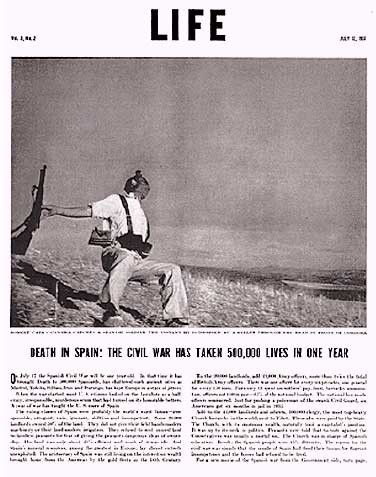
Photojournalist; Robert Capa Death of a Loyalist Militiaman, Cerro Muriano,
Córdoba front, Spain
, September 5, 1936. published in the Life Magazine.

The earliest history of war image that caused controversy in the world, is the image above by Robert Capa which real name is Andre Friedmann popularly known as Robort Capa.

Capa was a war photojournalist in the 1900s. Robort was born in Germany but left Hungary in 1930 for Berlin. Capa went to school in Deutsche Hochschule für Politik as a student of journalism and political science.

Later he worked as an assistant in the darkroom at Deutsche Photodienst Agency. He later moved to Spain from Germany in 1933 due to the rise of the Nazis where he shared the darkroom with Henri Cartier-Bresson and Chim (David Seymour).

He covered a lot of war during these periods, example is the Death of a loyalist soldier in 1936 which tagged him ‘the greatest war photographer in the world’. He later died when he went to cover the French war in Indochina for LIFE magazine in 1954 when he stepped on a landmine.

Robert Capa in an interview said he made his original photo of the Spanish Civil War while never glancing through his viewfinder. Broadly thought to be a standout amongst the best battle photos ever constructed, and the first to demonstrate front line death in action, Capa said in a 1947 radio interview that he was in ditches with Republican military men.

The men would pop over-the-ground to charge and shoot old rifles at a machine gun watched by troops faithful to Francisco Franco. Every time the military men would get gunned down. Amid one charge, Capa held his camera over his head and pressed the shutter speed.

The outcome of the shot is the image of a soldier who slumbered downward in a dramatic way. During the 1970s, decades after it was distributed in the French magazine Vu and LIFE, a South African columnist named O.D. Gallagher asserted that Capa had disclosed to him the picture was arranged. Be that as it may, no affirmation was ever displayed, and most trust that Capa’s is a veritable authentic photo of a Spanish minute man being shot.

 Capa’s picture raised war photography to another dimension well before writers were formally implanted with battle troops, appearing critical, if hazardous, it is for photojournalist to be amidst the activity.

Second image

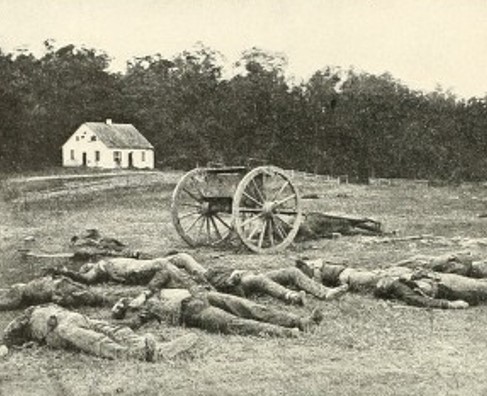
Dead Confederate artillerymen, photographed by Alexander Gardner in front of Dunker Church after the Battle of Antietam, September 1862 published in the New York Times in 1862

The one-day battle of Antietam marred over 23.000 people, making it the bloodies day in history. The Union triumph at Antietam brought about President Abraham Lincoln issuing his Preliminary Emancipation Proclamation on September 22, 1862. The war started in September 17, 1862, between Confederate General Robert E. Lee’s Army of Northern Virginia and Union General George B. McClellan’s Army of the Potomac, close to Sharpsburg, Maryland and Antietam Creek. (Vermilya D. 2003-2109)

Photos of the Civil War rapidly ended up well known among the overall population in view of the stunning and realistic nature of the photographs. These photographs gave individuals at home the opportunity they never had to see the wickedness of war with their own eyes. War was all the time romanticized in the Victorian time and these pictures clarified that the demise and destruction were not something to joke or boast with.

The kind of photography utilized during the civil war was known as wet-plate photography. Taking of pictures then was tedious and time consuming. Photojournalist needed to carry majority of their overwhelming hardware, including a portable dark room, to the war zone on a wagon.

The photojournalist Alexander Gardner was born in October 17, 1821 – December 10, 1882. Gardner was born in Paisley, Scotland in 1821. He lived in Washington until his death in 1882. Regarding his work he said, “It is designed to speak for itself. As mementos of the fearful struggle through which the country has just passed, it is confidently hoped that it will possess an enduring interest.’’

This image really caused uproar in New York when the New York TIMES mentioned the images and where to go see them. People were really shocked by the image that they refer to those images as bringing the dead right to their doorstep. The image brought change in the society.

It changed how people saw the war and what ‘conquering the war’ meant (a son losing his father, a wife losing a husband etc). Although the cameras in those times cannot take motion or action images. Gardner still tried to take still images to show the horror of the civil war and in those images, I could see the sadness and vanity in the images. For the images to get to me in this century I wonder how people then must have reacted to the images. Gardner reportedly look 70 pictures of the war within two days

Third image

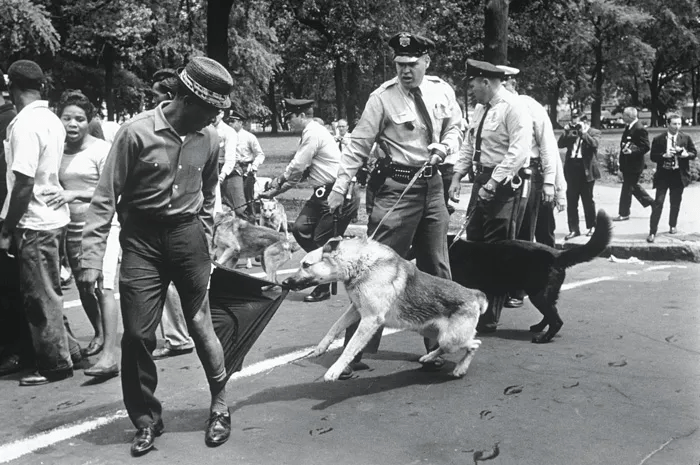
Image about the Birmingham, Alabama civil right movement. Image taken by Charles Moore in 1963 and the image was published in the Life Magazine

Controversial images have changed the opinion of the public. One of these issues was the Civil Rights development somewhere between 1954 and 1968 all through America. One of these high-clash territories was Birmingham in Alabama. (Goldberger B.& Co 2019)

From the image above police brutality to the people of colour can be seen. This image shows fear and oppression the police man installed on the people and how they could easily use their power to oppress the civilians.

Here, dark occupants and partners always conflicted with white power in a battle to end segregation. Charles Moore, a photographer for Montgomery Advertiser and Life got himself part of these contentions. (Goldberger B.& Co 2019)

This local Alabaman and child of a Baptist minister saw the viciousness and wound up dismayed by it. Even though he caught numerous pictures concentrating on this development, it was the above picture that caught the segregation as a reality. (Goldberger B.& Co 2019)

The violence was fierce, yet normal and easy-going. The picture distributed in Life magazine enabled the remainder of the world to perceive what was going on. 

When the picture was published in the life magazine, it quickly became obvious to the rest of the world what Moore had long known: ending segregation was not about eroding culture but about restoring humanity. (Iveta 2017) The Civil Rights Act was passed a year later, abolishing segregation.

Forth image

Iraqi Girl at Checkpoint. photographed by Chris Hondros in 2005

War photographers still take touching war photographs in these recent times, example is the image above. This image showed the horror of war and how it costs a little girl her parents and almost claimed her life too.

This hard-hitting picture of Samar Hassan occurred in 2005 when the war in Iraq was at its most brutal. Positioned with the Army unit was Chris Hondros a war photographer. He witnessed when the soldiers shot at a family of three thinking the truck conveyed insurgents and suicide bombers.

The soldiers killed Samar Hassan’s parents on their way back from Iraqi city of Tall ‘Afar and she was left covered in blood wailing at the back seat. From the image one could feel the young girls sorrow, pain and fear. The photographer Hondros took the image of the girl when she was taken out of the car. (Goldberger B.& Co 2019)

He turned his camera towards the young girl when the shooting happened. He transmitted the pictures quickly, distributed the world over the next day.

Considering this picture, the US military overhauled their checkpoint systems. They likewise experienced harsh criticism since for what reason would they say they were executing the very individuals they were there to free or protect. (Goldberger B.& Co 2019)

This is said to have been happening, but no media coverage has exposed such issue but with this image the U.S. government regulated the checkpoint system. This image brought people together to know the horror the US army cause to the people

This rapidly ended up a standout amongst the most dubious pictures in the media. You can nearly hear the young lady’s shout. (Goldberger B.& Co 2019)

 Hondros the photographer was killed during the civil war in Libya in 2011.

Other images

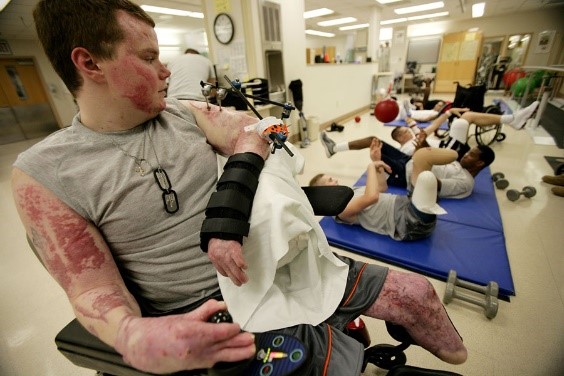
One big war photojournalist still cover is the Iraqi war. Although the images still haven’t stopped the war, but they have received sympathy from the members of the public all over the world. Through publishing these images below aids have been provided to the people affected by the war.

The first image depicts the horror of the war on soldiers. Marine Sergeant Kevin Downs, 21 seen in a rehabilitation centre exercising his body. He had a fourth degree born and lost both his leg due to the war. Image taken by Brent Stirton. Alan Taylor (2018)

The second image taken by Ali Abu Shish of the Reuters shows how Iraqi workers cleaned dirt beside a pool of blood of 115 people killed by a sucide bomber and wounding 148 people on February 28, 2005.

The third image was taken by Damir Sagoli of Reutrers in 2003. This image show terrified Iraqi children protecting themselves from the cold after they’re taken outside of their house by the U.S. army during an early morning raid. Alan Taylor (2018)

The forth image was taken by Adem Hadei in 2007. The image shows a grieving woman holding her dead six-year-old boy who was murdered by gunmen in Iraq. Alan Taylor (2018).

All these images were taken by people who felt the need to inform people of the horrors of war even though in the processes they automatically put themselves in danger. Some of these war photographers may be lucky and have a good life after the war, but most of them are always murders or killed during the war.

Coconut oil DIYS

flickr by Utkarsha Singhroul image of coconut oil

Coconut oil are given little to no credit for what they do. They are made from coconut. The oil in coconut is extracted to make the oil. There are lots of benefits of using coconut oil, they are… coconut oil has various use they can be eaten, used as moisturizer, used as makeup removal, used to make facial scrub and lip scrub and hair mask.

This article shows you tricks to using coconut oil as a DIY(Do It Yourself)

Homemade Mayonnaise

If you want to make homemade mayonnaise, and don’t want to buy from the stores here are the ingredient. Make sure before you start that all the ingredients listed below are at room temperature.

  • Raw eggs (yolk) 4-5
  • Powdered mustard 1/2tbsp
  • Salt. A pinch
  • Apple cider vinegar (mother) 2tbsp
  • Coconut oil 3tbsp
  • Herbs(optional) 1tbsp

Preparation

  • Separate the egg yolk and white in a bowl
  • Pour the egg yolk into the blender or food processor with the powdered mustard and salt.
  • Add any choice of herb or spice that you will like to try.
  • Add the apple cider vinegar
  • Blend the ingredients together and add the coconut oil in very little quantity at a time so that the oil can mix properly with the egg.
  • Scoop out from the blender and store in closely tight container and store in the fridge and consume within 2 weeks.

Coconut oil as moisturizer

If you have dry skin and your body lotion is not moisturizing your dry skin properly we got you covered.

You can easily use coconut oil as your body cream. You can rub coconut oil on your sink immediately after having your bath in order to restore and give instant shine to the skin. Or get a container and put in coconut oil then add your favorite lotion and mix thoroughly to make a smooth paste. Rub this on your body and see your skin come to live and moisturized all day long.

Coconut oil as a makeup remover

Gather here makeup lovers, do u have a hard time removing eye makeup and matte lipsticks? What if I told you coconut oil can easily take that down for you. All you have to do is put coconut oil on a cotton wool, an use it to clean off eye makeup and stubborn lipsticks. This can also be used to remove foundation and any form of makeup. It dissolves makeup fast and effectively leaving skin clean and moisturized. 

flickr by sathish mrb image shoeing coconut oil.

Coconut oil as hair mask or protein treatment

Coconut oil is one of the best oil to use for the hair because it protects the hair from damage. It can be used as hair cream, hair mask and for protein treatment.

For hair mask, mix honey and coconut together in a container and apply on the root and strands of hair and cover with a shower cap or plastic bag for 30 minutes and rinse off with warm water.

To use coconut oil as protein treatment for hair, you need one egg,(you can use two or more based on hair volume and length) two table spoon of honey, coconut oil, and any other type of oil you like. Mix all this together in a bowl and apply from root to strands of hair and cover with a plastic bag and leave on for 60 minutes and rinse off with look warm water to avoid cooking the egg in your hair.

Coconut oil can also be used for chapped lips. You can always keep coconut oil handy to use whenever your lips are dry.

Coconut oil can be used as face and lip exfoliator. If you have white heads and black heads on your face and chapped lips coconut oil should be your friend.

To use coconut oil as a face exfoliator, all you need is baking soda. Add baking soda to a bowl containing 1tbsp of coconut oil and mix in properly to make a paste then apply to the paste to the face and scrub in to exfoliate the skin. Rinse the face properly with warm water after 5mins.   

To use coconut oil for chapped lip all you need is sugar. Add sugar to 1tbsp of coconut and mix properly to form a thick paste. Apply and rub this into the lips for 3-5mins to remove dead cells from the lips.

Why Seasonal Vaccine is The Best for Your Loved Ones.

By Aishat Ibrahim

flickr image by Lance McCord. picture of a lady taking a shot

Need your children and loved ones to feel safe and healthy this winter and be able to fight of flu outbreak? Why not take them for the vaccination.

Each flu season is different, and influenza can affect people differently, but every year millions of people get flu, hundreds of thousands are hospitalized, and thousands to ten thousand people die each year from flu-related causes. The best way to help protect against flu is through an annual seasonal flu vaccine.

The virus (flu) infects the lungs and the upper airways, causing extreme high temperatures and general aches and pains, headache, fatigue and exhaustion. Symptoms can continue for up to a week.

The flu vaccine helps produce antibodies in the immune system to fight influenza virus. If the jab has been taken and the individual comes in contact with the virus, the vaccine will be attacked by these antibodies to stop the body from getting sick. Within two weeks, the flu vaccine will begin to work.

According to the Centres for Diseases Control  and Prevention (CDC) the benefit of getting the flu vaccination is enormous as it keeps the body from getting sick, reduces the risk of flu-associated hospitalization for children, working age adults, and older adults, helps protect people around us especially people with certain chronic health conditions (such as people with HIV, Cancer etc. ).

People from the age of 65, pregnant women, children, people with Down syndrome, people who work in the healthcare sector, or a carer, and people who works with pig, poultry and water fowl are in the at-risk group are urged to take the vaccination as not taking them may lead to serious health risk or infecting others. They are advised to take the vaccination because their immunity is low.

The HSE who is doing a remarkable work in announcing that the seasonal flu vaccination should be taken in order to not have to deal with the pain that comes with the flu, has advised anyone who is at a risk of contracting the virus to please walk into a pharmacy, GP office, or an occupational health department to have their shot of the vaccination.  The HSE also announced that the shots are available from October 2019 till April 2020, as that is when the flu spreads like wide fire during winter because of the cold.

There is nothing that has an advantage that doesn’t have its disadvantages, the flu vaccination also has its disadvantages. Dr Jill Seladi-Schulman, explained in an article that an individual can get the flu shot and occasionally, still come down with the flu. It takes about two weeks for your body to develop immunity after getting the vaccine. You can still get the flu during this time.

“If you have a negative reaction to the vaccine, you usually experience symptoms within minutes to hours of receiving the vaccine”. Symptoms may include:  wheezing, difficulty breathing, rapid pulse, swelling of the hives or rash around the mouth and eyes, and feeling weak or dizzy said Dr Jill. There are also people who shouldn’t take the vaccine they are Children younger than 6 months of age and people with severe reactions to the flu vaccine or any of its components.

He also continued to say that the flu can cause the Guillain-Barre syndrome which is a rare condition in which the immune system starts destroying the peripheral nerves. He advised the general public that if they have influenza vaccination questions or concerns, they should contact their doctor about it.

Families are advised to take the shots yearly to prevent falling sick. Please make sure your loved ones are protected this season. If you don’t take care of them who will? For more information about the flu vaccination contact the HSE at 041 6850300 or hselive@hse.ie or walk into the nearest pharmacy or visit your GP.

Snowfall- Movie Review

This show is about a boy named Franklin Saint. He and some of his friends and extended family decided to get into the cocaine business as a way to bring in more money to the family. They lived in the ghetto and wanted to elevate their social status. Franklin makes contact with a guy name Avi Drexler. The intent was to buy a small quantity and sell and see how it goes. The money kept coming in, in multiple folds and the intention soon changes. Franklin makes contact with a bigger supplier names Teddy McDonald who is CIA agent shipping cocaine into the US to fuel their war in the middle east. Franklin’s girlfriend has a cop for a father who can feel in his gut that franklin is up to something shady but he can’t prove it.

Queen of the South

This show is about a young Mexican woman named Theresa Mendoza. In this show, you will see Theresa who changes money on the streets of Mexico become the largest cocaine distributors in the southern US. She had large distributors in Mexico she sold too, she had drugs coming in from Columbia and Europe. She has a left hand man who is a Mexican Hitman, Pote Galvez, a very trigger happy person.

Her right-hand man is James Valdez, He’s a former army sergeant. He was in the First Calvary, based in Texas. When there was a hit out on Camila, James saved her life calmly. This loyalty won her trust and since then, James has served Camila. While she was changing money of the streets of Mexico, she met a drug dealer named El Guero. She became Friends with his Friends which was where she found her best friend Brenda Parra who has a son with her boyfriend, El Guero’s friend. El Guero and his friend work for Don Epifanio Vargas, who is the largest cocaine distributor at that time, south of the border. Guero and his friend try to steal from Don Epifanio and soon got themselves killed leaving Theresa with a ledger containing details of dealing with the drug king pin Don Epifanio. She tries to flee Mexico and she enters a prostitution ring that send girls to the US to work of their payment as drug mules. She hid the book at a public bathroom ceiling to use as bargaining chip if the need arose. The person in charge is none other than Camilo Vargas who later decides to start her own drug empire north of the Mexico/US border because she isn’t being recognised high enough in the drug food chain as she should be. Camilo finds out how important Theresa is to her husband and tries to use her as a chip to bargain with against her husband. Theresa who is tired of watching over her shoulders sees an opportunity to make some serious money from dealing drugs so she can buy or own protection that covers her, Brenda and Brenda’s son Tony.

You- Movie Review

pinterest by R& 

This show is about a guy named “Joe Goldberg” who goes by “Will Bettelheim” now. In the first season Joe killed the person he is dating Beck, but that’s not where your focus should be. We would be focusing more on the second season

In season two Joe, sorry now Will moves to L.A just to get away from his ex-girlfriend Candace Stone, who after breaking up with Joe got kidnapped by him and forced to where he called their favourite picnic location. She then tries to escape, Joe catches up to her and there is an altercation between them and as Joe tries to pin her to submission, her hits her head too hard on a piece of wood and she got knocked out. Joe thought she was dead, panicked and buried her in a very shallow grave and covered his tracks as best as he could. When she woke and tried to tell the cops she ended up in a mental institution

Will in L.A finds works in a grocery store called ANAVRIN – yes, it’s nirvana backwards – where he meets the baker of the store and also owner’s daughter called Love and then he fell in love. He has a childhood trauma that makes him seek love so hard and tries to fix the person he falls for. In season one he killed some people he thought was toxic for Beck. He can be an extremist but he soon discovers that the love he has for Love is making him a better man which he wants to desperately become.

The third season of Netflix’s You will be released on Friday 9 April 2021. I an excited for the 3rd season are you!!!

Design a site like this with WordPress.com
Get started